

KL Property Under RM1 Million: What RM700k–RM1m Actually Buys in 2026

A path-based guide to space, newness, and address trade-offs in Kuala Lumpur’s RM700,000–RM1 million band.
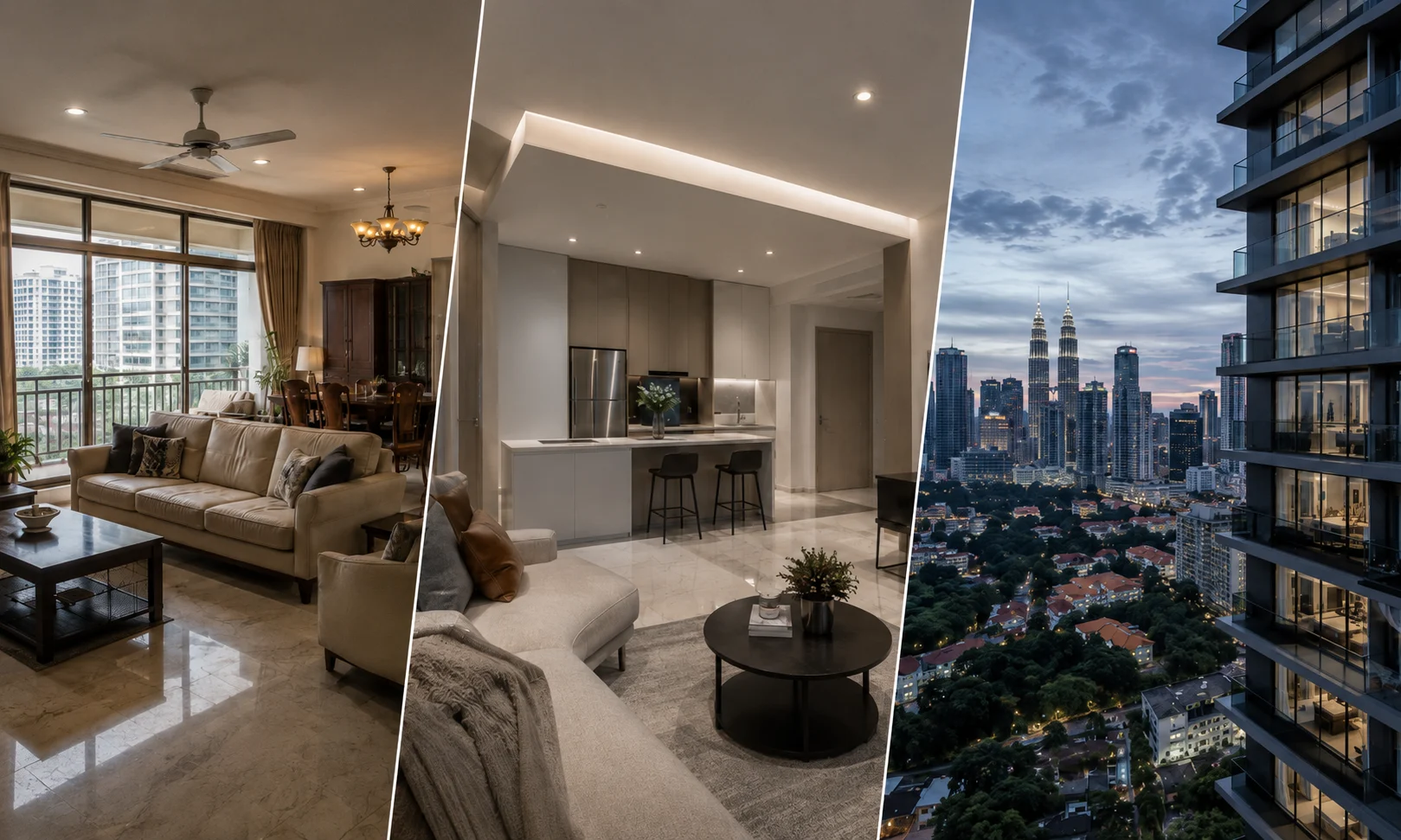
If you’re looking at KL property under RM1 million, it mostly means strata condominiums, not landed houses. At this budget, you’ll usually get two of three things: space, newness, or address, and this band sits above every first-time buyer scheme in Malaysia.
At Hartamas Real Estate, we work with buyers in this exact price band every week, so we know where the trade-offs really bite. This guide walks you through three ways to spend RM700,000 to RM1 million in Kuala Lumpur, written for upgraders, growing families, and investors moving past the entry-level market.
TL;DR: Quick Summary
RM500,000 is the real dividing line: every stamp duty exemption and first-home scheme in Malaysia stops at or below this price, not at RM700,000.
Expect two of three, not three of three: space, newness, and address rarely come together in this budget.
This price band made up 16.9% of national residential transactions in 2025: there is more inventory here than search results first suggest.
New launch and subsale each solve a different problem: neither is automatically the better use of this budget.
Six listings beat fifty: filtering hard before viewing saves weeks of wasted appointments.
Table of Contents
What Does RM700,000–RM1 Million Actually Buy in Kuala Lumpur?
RM700,000 to RM1 million buys mostly strata residential property in Kuala Lumpur, not landed houses.
- Landed property inside KL city limits exists at this price, but it is uncommon.
- It tends to be older, smaller-lot, and leasehold.
- Outcome depends more on a building’s age and micro-location than the neighbourhood name.
- Two projects 400 metres apart can differ more than two suburbs kilometres apart.
What Three Things Can This Budget Maximise?
This budget can usually maximise two of three things: space, newness, or address.
- Space: a larger built-up area, usually in an older building.
- Newness: recent layouts and facilities, usually in a smaller unit.
- Address: a well-known location, usually at the cost of size or age.
What Does This Budget Not Buy?
This budget won’t buy you a large new unit in a prime address with two car parks and no renovation needed.
Expecting all of that at once will cost you weeks of searching for something that simply doesn’t exist in this range.
| Pro Tip
We’d always suggest ranking your top two priorities before your first viewing. It stops you from comparing homes that can’t fairly be compared. |
|---|
| Quick Answer
What does RM700,000 to RM1 million buy in Kuala Lumpur in 2026? Mainly two- and three-bedroom strata homes. Established addresses mean older or smaller stock. Mature suburbs mean more floor area, usually in older buildings. Landed property within KL at this price is limited. |
|---|
Why Does RM500,000 Matter More Than RM700,000 or RM1 Million?
RM500,000 matters because government support for buyers stops there, not at RM700,000 or RM1 million.
- Full exemption: the stamp duty exemption covers both the Memorandum of Transfer and the loan agreement.
- It applies only to homes priced at RM500,000 or below.
- Budget 2026 extended it to 31 December 2027.
Every price-capped first-home scheme and incentive, including the full stamp duty exemption, SJKP government guarantees, and PR1MA, caps at or below RM500,000, well before this RM700,000–RM1 million budget begins.
Civil servants have a separate route: LPPSA financing, raised to a RM1 million ceiling under Budget 2026. That’s not a comment on fairness, just the arithmetic you need to plan around.
See our 2026 guide to first-time home buyer schemes in Malaysia for more government-backed financing options.
Why Isn’t the Bank’s Maximum Loan the Real Budget?
The bank’s maximum loan is not the real budget, because statutory costs come out of your own cash, as illustrated below.
| Purchase price | Transfer duty | Loan duty (90% margin) | Statutory total |
|---|---|---|---|
| RM500,000 (first home, qualifying) | RM0 | RM0 | RM0 |
| RM700,000 | RM15,000 | RM3,150 | RM18,150 |
| RM800,000 | RM18,000 | RM3,600 | RM21,600 |
| RM1,000,000 | RM24,000 | RM4,500 | RM28,500 |
Source: Stamp Act 1949, First Schedule, LHDN (2026). Exemption applies to Malaysian citizens who have never owned residential property, for SPAs signed by 31 December 2027. Confirm current terms with LHDN before relying on this for a specific purchase.
| Pro Tip
Budget your statutory costs as cash on top of your down payment, not inside your loan. Banks won’t finance your stamp duty. |
|---|
Further readings:
Which Non-Negotiable Should You Choose Before Picking an Area?
We’d encourage you to choose no more than two non-negotiables before you start browsing listings.
Three or four requirements usually push your budget past what’s realistically available, and each added requirement narrows the pool further.
- Three actual bedrooms versus a flexible study
- Two usable car parks versus tandem parking
- Walkable rail access versus “near MRT” in marketing copy
- Move-in condition versus a willingness to renovate
Should You Search Up to Your Bank’s Maximum Loan?
The bank’s maximum loan approval marks a ceiling for you, not a safe search target.
Bank Negara Malaysia held the Overnight Policy Rate at 2.75% at its 9 July 2026 meeting. A floating-rate instalment moves with future changes to that rate. It’s worth modelling an increase yourself, rather than assuming today’s rate holds.
If you’re buying to live in it, plan for the household you’ll have five years from now, not just the one you have today. Think about children, ageing parents, working from home, a second vehicle, or a change of school or workplace.
|
Quick Decision Rule
|
|---|
| Pro Tip
Write your two non-negotiables down before you open a single listing. It’s the fastest way we know to cut a fifty-listing search down to size. |
|---|
What Are the Three Ways to Spend RM700k–RM1m in Kuala Lumpur?
There are three main ways to spend this budget in Kuala Lumpur: maximise space, maximise newness, or maximise address.
Path 1: How Do You Maximise Space in This Budget?
You maximise space by buying older, larger stock in mature suburbs, or a small pool of older landed property at the KL fringe.
- Mature Cheras and Taman Midah
- Setiawangsa and Jelatek
- Old Klang Road
- Older stretches of TTDI
Confirm current listings and comparables for a specific project. Do not assume an area-wide rule applies to the whole corridor.
Large older units tend to price below smaller new ones for consistent reasons: building age, older specifications, renovation burden, and a buyer preference shift toward newer, compact stock.
Why Can Low Price-Per-Square-Foot Mislead?
Low price-per-square-foot can mislead because it hides costs that sit outside the purchase price.
- A buyer might not need all the space.
- Renovation costs can be substantial.
- Maintenance collections in older buildings are sometimes weak.
- Major works, such as roofing, lifts, and waterproofing, may be pending and unbudgeted.
Worth checking before offering: sinking fund health and repair history, lift and water-system condition, electrical load, car park allocation, AGM minutes where obtainable, and recent registered transactions in the same stack.
This path suits multi-generational households, long-horizon owner-occupiers, and buyers who can fund renovation separately from the purchase budget.
Path 2: How Do You Maximise Newness and Integration?
You maximise newness by choosing recent developments with mall or transit integration and minimal fit-out needed.
- KL East and Taman Melawati
- Setapak and Wangsa Maju
- Newer stock along Old Klang Road
- Bangsar South
These are not one homogenous market. Commute patterns differ materially between them.
The premium buys newer common facilities, greener surroundings in some projects, mall proximity, current fittings, and a lower renovation reserve.
- Test actual door-to-door peak-hour commute, not drive-time claims.
- Test genuine walkability to rail, not marketing-copy “proximity.”
- Check whether an 800–900 sq ft layout suits a household likely to grow.
- Check whether mall integration matters to your routine, or is being paid for unused.
The risk here is paying for facilities while accepting a layout that won’t hold your household in five years. We’d always test claims such as “15 minutes to KLCC” in person.
Path 3: How Do You Maximise the Address?
You maximise address by trading floor area or building age for an established, recognisable location.
- TTDI
- Dutamas
- Mont Kiara
- Bangsar and the Bangsar fringe
- The Seputeh fringe
The trade is straightforward. The postcode shrinks the unit. Moving from Old Klang Road toward Bangsar at the same budget can cut built-up area substantially.
“Mont Kiara” and “Bangsar” are sometimes marketing labels, not precise micro-locations. What is on the title, and where the project sits on a map, matters more than the brochure.
- Building age and façade condition
- Sinking fund health
- Car park count
- Residential versus serviced-residence title
- Genuine walking distance to the amenities the address implies
This path suits buyers who value the surroundings themselves, and are willing to inspect older buildings carefully, not buyers purchasing primarily for the name.
| Pro Tip
Match your path to your household’s timeline, not to what looks impressive in a listing photo. The wrong path at the right price is still the wrong home for you. |
|---|
| Path | Corridor example | Typical building era | Typical built-up | Bedrooms | Main compromise |
|---|---|---|---|---|---|
| Space | Cheras / Taman Midah | 1990s–2000s | 1,000–1,400 sq ft | 3 | Renovation and sinking fund need checking |
| Space | Old Klang Road | 1990s–2000s | 1,100–1,500 sq ft | 3–4 | Building age and car park allocation vary widely |
| Newness | KL East / Setapak | 2015 onward | 750–950 sq ft | 2–3 | Smaller layout; verify actual rail walking distance |
| Newness | Bangsar South | 2012 onward | 700–900 sq ft | 2 | Mall-integrated premium; confirm real commute time |
| Address | TTDI / Dutamas | Mixed, older core | 900–1,200 sq ft | 3 | Address premium narrows built-up at this price |
| Address | Mont Kiara / Bangsar fringe | Mixed | 700–1,000 sq ft | 2–3 | Confirm title is residential; check exact map location |
Source: Hartamas negotiator market observation (2026). Illustrative corridor ranges by building generation, not individual current listings, transacted values, or area medians. For live asking prices on specific units, contact a Hartamas negotiator.
Ready to compare your options? Explore current homes for sale in these Klang Valley neighbourhoods, or check an indicative property value before making your next move.
- Hartamas TTDI listings
- Mont Kiara listings
- Old Klang Road listings
- KL East and Melawati listings
- Property value estimator
New Launch or Subsale: Which Uses This Budget Better?
Neither new launch nor subsale is automatically the better use of this budget.
It really depends on what you’re optimising for, not the product type. A new launch price can embed packages, rebates, and a future completion date. A subsale property can be inspected today and checked against JPPH registered transactions.
- A new launch may suit buyers who want: lower immediate fit-out cost, current specifications, and a longer runway before the space needs to fit a growing household.
- A subsale may suit buyers who want: certainty over what they are getting, verifiable comparables, and larger layouts per ringgit.
We’d always run the comparison on total cost, not SPA price. That means including progressive interest during construction, renovation and furnishing, maintenance from handover, and any rent paid while waiting.
A new launch here competes for resale buyers against the developer’s own unsold inventory in the same project, so we’d always ask how many units remain unsold. This affects resale timing, not future price.
| Pro Tip
We’d always ask every new launch sales gallery for the current unsold-unit count in the exact project, not the developer’s portfolio-wide figure. |
|---|
| New launch | Subsale | |
|---|---|---|
| Unit certainty | Lower until completion | Higher, inspect today |
| Completion timing | Set by developer schedule | Immediate |
| Floor area per ringgit | Often lower | Often higher |
| Upfront cash | Lower initial outlay, staged | Full down payment upfront |
| Renovation requirement | Minimal | Varies with building age |
| Building history available | None yet | Available via management |
| Transaction comparables | Limited until handover | JPPH registered data |
| Main execution risk | Developer delivery, unsold overhang | Building condition, hidden costs |
Source: Hartamas negotiator review (2026).
Further reading:
What Does “Cheap” Actually Mean in This Price Band?
An asking price only really means something once you compare it against a real registered transaction.
- Asking price against JPPH registered transactions in the same development.
- A rebate or cashback built into the headline price.
- One unusable, remote, or tandem car park counted as two.
- Maintenance and sinking fund left out of the affordability sum.
- Serviced-residence cost structures priced as standard residential.
- A study or utility area marketed as a bedroom.
- Buildings some banks lend against reluctantly, a resale constraint for the next buyer too.
- Infrastructure priced ahead of delivery, such as MRT3.
None of this makes a property bad on its own. Each point just needs to be reflected in the price.
Are the Unit, Building, and Location Problems the Same Risk?
A unit problem, a building problem, and a location problem carry different levels of risk.
- A unit problem is fixable with money.
- A building problem needs every other owner’s agreement.
- A location problem is generally not fixable at all.
| Pro Tip
We’d always price a building problem and a location problem more conservatively than a unit problem. Money alone won’t fix either. |
|---|
| Quick Answer
A property is not “below market value” simply because its asking price is lower than another listing. A defensible comparison needs recent registered transactions from the same or a genuinely comparable development, adjusted for size, condition, floor, car parks, and unit attributes. |
|---|
Further reading:
- Don’t Buy the Hype: How to Spot a Speculative Trap
- 9 Things to Check Before Paying a Property Booking Fee
How Do You Build a Six-Listing Shortlist Instead of a Fifty-Listing Watchlist?
We’d suggest picking two contrasting paths, shortlisting three units in each, and scoring all six the same way.
One path should maximise your first non-negotiable. The other should be the financially safer choice.
- Price band
- Minimum built-up
- Actual bedroom count
- Minimum car parks
- Maximum building age
- Title and product type
- Maximum realistic commute
We’d remove listings with missing critical information before viewing, not after.
What Should You Ask Before and After Viewing?
- Before viewing, confirm: built-up area against the title, current maintenance and sinking fund, car park allocation, and title type.
- Before offering, ask for: recent registered comparables, known building issues, seller motivation, and a full cash-required breakdown.
| Pro Tip
We’d score every listing on the same nine fields: asking price, registered comparable evidence, built-up, usable bedrooms, car parks, monthly maintenance, renovation estimate, real commute, and reason to reject. |
|---|
What Do Buyers in This Band Usually Ask?
Buyers in this band usually ask about areas, stamp duty, eligibility, size, and value.
What Areas in KL Can I Buy a Condo for RM700,000?
Mature suburbs and city-fringe corridors generally offer the most floor area. This includes parts of Cheras, Setiawangsa, Old Klang Road, and KL East, per NAPIC and JPPH registered transactions. Pricing shifts by project and quarter, so check current listings directly.
How Much Stamp Duty Do I Pay on an RM800,000 Property?
Around RM21,600 in statutory duty. That is RM18,000 transfer duty plus RM3,600 loan agreement duty on a 90% loan, per the Stamp Act 1949, First Schedule. This excludes legal fees, valuation, and other completion costs.
Do First-Time Buyer Schemes Apply at RM700,000?
First-time buyer schemes stop before this budget starts. The full stamp duty exemption, Skim Rumah Pertamaku, and PR1MA cap at RM500,000. A buyer at RM700,000 pays the standard ad valorem rate throughout.
Where Can I Get the Largest Condo Below RM1 Million in KL?
Mature suburbs with older stock, such as parts of Cheras, Old Klang Road, and Setiawangsa, tend to offer the largest built-up area per ringgit. Larger older units typically carry higher renovation costs.
Should I Buy an Older Large Condo or a Smaller New One?
Neither is universally better. It depends on renovation tolerance, household trajectory, and how much you value current fittings versus space. A five-year view of the household usually clarifies the trade-off.
Is an Asking Price the Same as Market Value?
Asking price and market value measure different things entirely. Asking price reflects what a seller wants. Market value comes from recent registered transactions for a genuinely similar development.
The Bottom Line
Buying in Kuala Lumpur’s RM700,000 to RM1 million band comes down to trade-offs, not shortcuts. Space, newness, and address rarely arrive together at this price. The buyers who do well here pick two priorities early, then stress-test every listing against them, and we’d encourage you to do the same.
The stamp duty gap above RM500,000 is real, and it won’t disappear just because a listing looks like good value. A six-listing shortlist, tested against registered comparables, beats fifty tabs left open in a browser. That’s exactly where a conversation with a Hartamas negotiator can earn its place.
| Ready to Narrow Your Search?
The market moves fast, so speak to a Hartamas agent today and we’ll build a shortlist around your budget and timeline. Not sure which of the three paths fits your household? Tell us your budget and priorities, and we’ll help you narrow it down personally. |
|---|
