

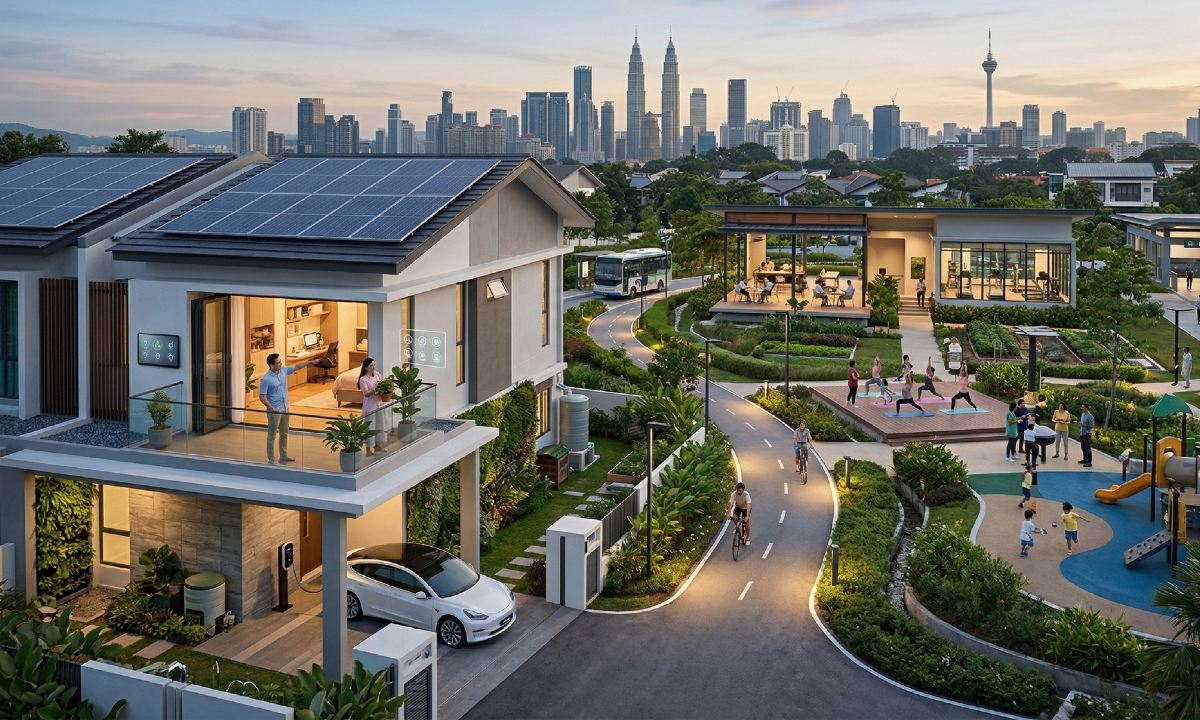

Ask most buyers what they want in a property and you’ll get the same answer: ‘location, location, location.’ Fair enough. But in 2026, that’s only the starting point.
At Hartamas, we speak to hundreds of buyers across KL and Selangor every year — first-timers, upgrading families, serious investors. And the shift in priorities this year is striking. Location still matters. But it’s no longer the whole story.
This guide breaks down what buyers actually care about in 2026: the real criteria, the trade-offs worth knowing, and the questions to ask before you sign anything.
TL;DR — The 2026 Buyer Checklist
- Transit connectivity beats raw location — MRT/LRT proximity now directly affects resale and rental value
- Developer track record matters more than ever — buyers are paying a premium for Build-Then-Sell certainty
- Green credentials are no longer a bonus — GBI/GreenRE certification saves money and commands higher resale prices
- EV charging is becoming a dealbreaker for condo buyers — check the MC’s stance before you commit
- Smart home backbone adds lasting value — wiring, PoE, and HEMS matter more than cosmetic finishes
- Suburban landed in Selangor is the sweet spot for upgrading families in 2026
- KL high-rise overhang is real — selectivity is essential, especially in the RM500k–RM1M range
1. The Macro Picture: Why 2026 Is a Good Time to Buy
Let’s start with the good news. The fundamentals are genuinely supportive right now.
The Key Numbers
- OPR held at 2.75% — monthly repayments stay predictable for new borrowers
- GDP growth projected at 4.8%–5.0% — steady without overheating
- Unemployment at ~3%, inflation at ~1.8% — household finances are holding up
Budget 2026 added direct tailwinds for local buyers:
- Stamp duty exemption extended to December 2027 — for first-time buyers on properties up to RM500,000
- RM20 billion SJKP guarantees — now covers gig workers and the self-employed
- Madani Deposit Initiative — helps lower-income households clear the down-payment hurdle
- Foreign buyer stamp duty doubled to 8% — less speculative competition for local buyers
The caveat:
These incentives mostly help the entry-level and mid-market. Above RM1 million, Budget 2026 offers less direct benefit. And the KL high-rise overhang in the RM500k–RM1M band means negotiating power still sits with buyers in that segment.
2. Liveability Over Location: The 15-Minute City Shift
Here’s what we tell every client: buyers in 2026 aren’t just purchasing an address. They’re buying a lifestyle system.
The questions they ask us:
- Can I walk to a clinic or pharmacy?
- Is there a good school within reach?
- Will I be stuck in traffic just to get groceries?
The ’15-minute city’ concept — where daily essentials are reachable on foot or a short drive — has moved from planning theory to a genuine purchase criterion. Areas like Kepong and Sungai Besi have seen demand indices for serviced apartments rise over 30% year-on-year as a result.
What 'Liveability' Means in Practice
| Liveability Factor | What Buyers Want | Impact on Value |
|---|---|---|
| Transit Access | Walking distance to MRT/LRT station | Higher capital appreciation, stronger rental demand |
| Daily Conveniences | Supermarket, clinic, school within 15 mins | Faster take-up, lower vacancy for investors |
| Wellness & Green Space | Parks, jogging tracks, landscaped areas | Key differentiator for suburban landed townships |
| Functional Layouts | Home office space, flexible room configurations | Higher demand from remote workers and Gen Z buyers |
| Developer Trust | Proven delivery record, financial stability | Buyers pay a premium to reduce abandonment risk |
The trade-off:
Integrated townships further from the city centre offer better liveability value — but longer commutes for CBD workers. It depends on your work situation.
3. Developer Track Record: The Question Most Buyers Ask Too Late
Here’s something we say often: your developer builds your property once. Your management runs it for the next 30 years.
In 2026, execution certainty is a real premium. Developers with strong delivery records are commanding higher take-up rates — even at slightly higher launch prices. Buyers have learned the hard way that a great location means nothing inside an abandoned development.
What to Check Before You Commit
- Completed projects: How many in the last 5 years? Any delays or defects?
- VP delivery record: Did they hand over on time, or were buyers waiting years?
- Post-handover service: Is there a dedicated team, or does support disappear after handover?
- JMB quality: Is there a functioning Joint Management Body for stratified properties?
- Maintenance fee: Does it reflect the actual cost of running the building — or is it artificially low?
The flip side:
Build-Then-Sell (BTS) projects require a longer wait and may offer fewer early-bird incentives. A well-priced Sell-Then-Build from a reputable developer can still be a sound choice — just do your homework on their track record first.
4. Green Buildings: Not Just Ethical — Actually Cheaper to Own
About 75.8% of Malaysian homebuyers say they’d pay a premium for green features. Here’s why that makes financial sense:
- Energy savings: Green-certified buildings use 20%–30% less electricity than conventional stock]
- Water savings: Rainwater harvesting systems can cut consumption by up to 40%
- Higher resale value: ESG-conscious tenants and buyers push up prices over time
GBI (Green Building Index) and GreenRE are the two benchmarks to look for. In 2026, these certifications are increasingly appearing in mid-market launches — not just luxury projects.
Top Green Features Buyers Are Requesting
- Rainwater harvesting — cuts water bills meaningfully over time
- Solar-ready rooftops — add panels later without major retrofitting
- Natural cross-ventilation — reduces aircon dependency in common areas
- Low-VOC materials — better indoor air quality, especially for families with children
- LED lighting and energy-efficient lifts — the unglamorous stuff that actually cuts service charges
The honest caveat:
Not all ‘green-labelled’ properties deliver equal savings. Ask the developer for actual energy performance data — not just the brochure. For subsale properties, check whether any certification is still valid, and factor in potential retrofit costs.
5. Smart Homes: What Actually Adds Value vs. What's Just Marketing
More buyers are asking us: ‘Does it have smart home features?’ The better question is: which features actually matter?
Malaysia’s smart home market is projected to exceed USD 1.4 billion by 2034. In 2026, the focus has shifted to ‘Matter 1.3’ certified developments — an interoperability standard that makes Apple, Google, and Amazon devices work together seamlessly. No more compatibility headaches.
But the real value isn’t in the gadgets. It’s in the infrastructure behind them.
The Infrastructure That Matters More Than the Apps
- Wired Ethernet to office spaces and TV points — stable in a way that wireless simply isn’t
- Power over Ethernet (PoE) for cameras and doorbells — no separate power cabling required
- Dedicated tech closet in the floor plan — for routers, switches, and battery backups
- Home Energy Management Systems (HEMS) — AI-driven tools that schedule appliances and EV charging to lower-rate windows
A smart lock and a fancy app? Easy to add later. Proper wired infrastructure in the walls? You can’t retrofit that without a renovation. Prioritise the backbone.
6. EV Charging: The Divide Nobody Warned Condo Buyers About
More buyers are asking us: ‘Can I charge an EV here?’ And the answer is increasingly: it depends on which building you’re in — and that gap is widening fast.
| Factor | Landed Property | Stratified (Condo/Apartment) |
|---|---|---|
| Installation Cost | RM3,000–RM6,000 for 7–11kW Wallbox | Varies — requires MC approval and electrical assessment |
| Approval Process | Owner's decision, straightforward | Requires MC approval — can be slow or refused entirely |
| Home Charging Cost | RM30–RM40 for a full 60kWh charge | Same cost, if the infrastructure allows it |
| Annual Savings vs. Petrol Car | RM700–RM1,200 per year | Same, if you can charge at home |
| Future-Readiness | High — upgrade at any time | Depends on building's electrical capacity |
The reality:
If you don’t own an EV now and won’t for 3–5 years, this may not be your top priority. But if you’re buying a condo and plan to go electric, check the MC’s stance on private Wallboxes before you fall in love with a unit. Older buildings with inadequate electrical infrastructure are already seeing valuation penalties.
7. KL vs. Selangor: Two Very Different Stories in 2026
Kuala Lumpur: Selectivity Is the Whole Game
KL is the market for investors chasing capital preservation and corporate tenancies. The TRX effect is real:
- Grade A offices and The Exchange TRX mall — creating a high-income demand corridor nearby
- Incoming Monash University city campus — driving demand for studio and one-bed units in Bukit Ceylon and Taman U-Thant
- MRT Putrajaya and Kajang Line connectivity — now the primary driver of rental resilience in the city core
The value gap is also compelling. KL’s high-end units average USD 3,000–7,900 per sqm. Singapore sits at USD 19,000. That gap has real legs for long-term appreciation — but only for properties with genuine connectivity.
The challenge:
KL is sitting on 4,687 unsold completed units in the RM500k–RM1M range (Q3 2025 data). That’s buyer leverage — but it also means not everything in this tier is a sound investment. Stick to projects with direct MRT access or institutional anchor demand nearby.
Selangor: Where Upgrading Families Are Finding Value
Selangor leads Malaysia in residential transactions — 21.6% national share. And the dominant theme in 2026 is suburban landed homes.
Townships in Rawang, Semenyih, Bukit Raja, and Kota Warisan are drawing serious upgrader demand, with entry points at RM680,000–RM800,000.
What’s driving the move:
- More space for the money — larger built-ups and personal land vs. KL high-rise
- Gated-and-guarded environments — a non-negotiable for many families with young children
- Job-led demand — the Shah Alam–Klang industrial axis is creating real employment-driven housing need
- Manageable monthly repayments — RM2,500–RM3,500 with developer incentives factored in
Trade-off:
These areas are further from the KL city core. If you commute to the CBD daily, factor in realistic travel times — not best-case scenarios.
8. The Supply Picture: Why Fewer New Projects Is Good News
Nationwide, new housing starts are down 2% in 2026. Planned projects that haven’t broken ground are down nearly 18%. That might sound alarming. It isn’t. Less new supply means:
- Existing inventory gets absorbed faster
- Well-located properties see price firming
- Scarcity builds in genuine demand corridors — before it becomes obvious to everyone
| Market Segment | 2026 Situation | What It Means for Buyers |
|---|---|---|
| Serviced Apartments (KL) | Overhang down 11% YoY (Q3 2025) | Improving — but still a buyer's market in RM500k–RM1M |
| New Planned Supply (National) | Down 31.7% in 2025 | Scarcity forming in high-demand zones — act before it closes |
| Landed (Selangor) | 22.5% take-up rate for new launches | Moving fast — landed outperforms high-rise significantly |
| High-Rise Overhang (National) | 17,892 unsold units worth RM14.48bn | Buyer leverage remains — don't overpay in this segment |
Source: Napic data
The Bottom Line
The 2026 market isn’t one where you can buy anything, anywhere, and expect it to perform. But for informed buyers, it’s one of the better windows in recent years.
Whatever your buyer profile, the framework is the same:
- Prioritise transit connectivity over the postcode
- Verify developer track record before you fall in love with the render
- Check green certifications — they affect your bills and your resale price
- Ask about EV infrastructure before you sign for a condo
- Look at real supply and demand data, not just marketing narratives
Ready to Make a Move? Talk to Hartamas.
Knowing what to look for is one thing. Finding it — in the right project, at the right price, with the right terms — is where we come in.
At Hartamas, we’re not here to push you toward a development. We’re here to help you ask the right questions, read the numbers, and make a decision that fits your timeline and your life.
The 2026 window is genuinely one of the more favourable buying environments in years:
- OPR stable at 2.75%
- Government incentives still active for first-time buyers
- Supply tightening in high-demand corridors
- High-rise segment still offering buyer leverage
But windows don’t stay open. Every month of waiting brings you closer to the supply correction analysts are projecting for 2027 and beyond.
Finding the right property for your needs?
Contact Hartamas Real Estate today for a no-obligation property consultation. Whether you’re buying your first home, upgrading to landed, or building a portfolio — we’ll help you find the right fit, in the right location, at the right time.

How much housing loan you can get?

How much is your property worth?

Interested in new launch property?

Looking for property for sale or rent?
Subscribe to our email newsletter today to receive updates on the latest news, property guides, new launches, featured secondary market properties and special offers.
