
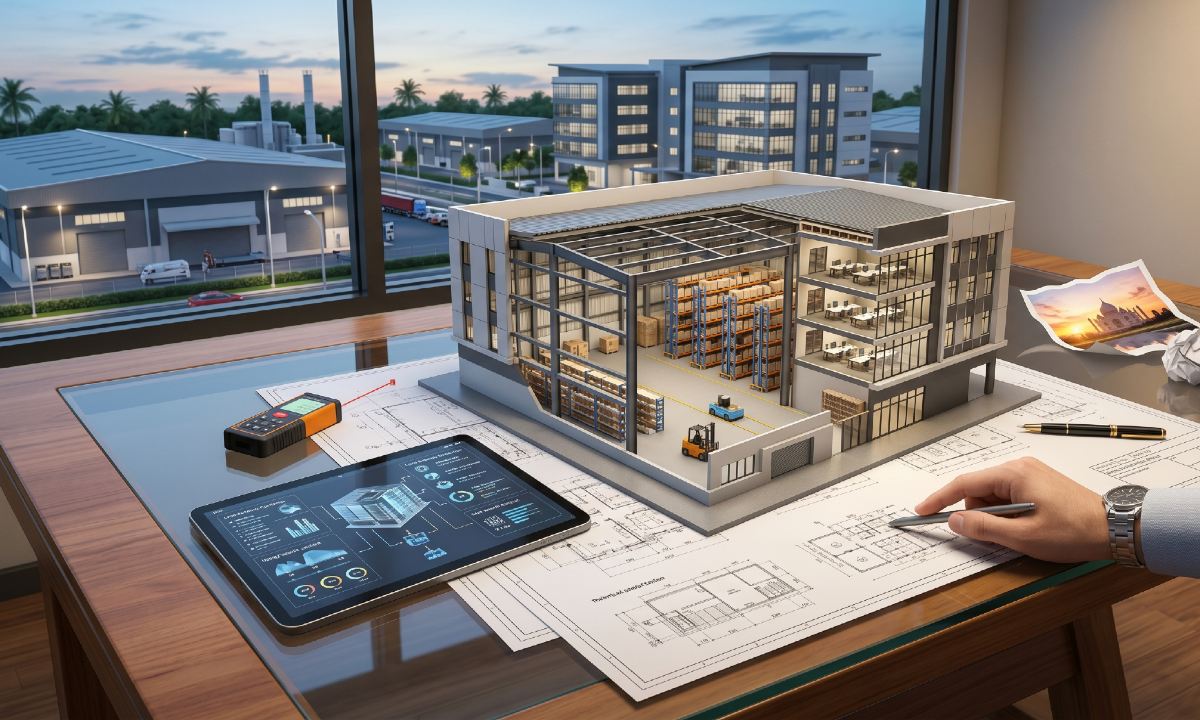
Ghost shop-lots. Stranded industrial land. Generic warehouses with no power. The commercial and industrial market in 2026 has clear winners — and costly traps. Here’s how to tell the difference.
Introduction
If you’re a commercial or industrial buyer in Malaysia right now, you already know the market has changed. The question is whether the property you’re considering has changed with it.
At Hartamas Real Estate, the conversations we’re having with commercial and industrial clients in 2026 sound very different from even two years ago. Our clients are asking about ESG certification, power grid capacity, anchor tenants, and water permits — not just location and price psf. And rightly so.
The commercial and industrial landscape in Malaysia has bifurcated sharply. Purpose-built, specification-grade assets are outperforming. Generic shop-lots in half-occupied townships and undifferentiated industrial land are struggling — quietly, and in some cases irreversibly.
This guide is for business owners, investors, and property decision-makers who want to know exactly where the value is, and where the traps are, in Malaysia’s commercial and industrial market in 2026.
⚡TL;DR – The Commercial & Industrial Fast Guide
- Malaysia’s data centre ecosystem has USD 34 billion in infrastructure deployment planned through 2028, but only ESG-certified, spec-grade industrial assets will benefit.
- Nearly 30% of data centre applications in Johor were paused in late 2025 and early 2026 over water resource concerns. Power availability alone is not enough.
- NAPIC data flags substantial empty commercial stock across Selangor and KL, particularly shop-lots in developments that never reached 50% residential occupancy.
- Budget 2026 (RM 419.2 billion) is directing capital into semiconductors, AI, and green tech — the sectors shaping industrial demand. GDP growth projected at 4.0–4.5%.
- Run the 3-point checklist: Exit Reality, Anchor Tenant Test, Spec Readiness, before committing to any commercial or industrial asset.
What’s Inside
- The 2026 Macro Picture: Where Demand Is Actually Coming From
- Industrial Property: The Star Performer of 2026 — With Conditions
- Commercial Shop-Lots: Where the Ghost Township Trap Lives
- Johor & the Southern Corridor: Real Opportunity, Real Risk
- Infrastructure That Actually Moves the Needle
- The 3-Point Checklist for Commercial & Industrial Buyers
- Which Commercial or Industrial Buyer Are You?
- Conclusion
1. The 2026 Macro Picture: Where Demand Is Actually Coming From
Commercial and industrial demand in 2026 is not broad-based. It is highly concentrated in specific sectors and corridors. Understanding this is the first step to making a sound investment.
| Macroeconomic Indicator | 2025 Value | 2026 Forecast | Commercial / Industrial Impact |
|---|---|---|---|
| GDP Growth Rate | 4.2% | 4.0% – 4.5% | Sustained demand for industrial and office space |
| OPR | 2.75% | 2.75% | Stable financing costs; predictable yield calculations |
| Ringgit (USD/MYR) | 4.60 | 4.00 – 4.50 | Boosts foreign capital into industrial & logistics |
| Federal Revenue (RM bil) | 334.0 | 343.1 | More fiscal space for ECRL & infrastructure upgrades |
| House Price Index Growth | 0.9% | 1.0% – 5.0% | Residential spillover supports mature commercial strips |
- Budget 2026 (RM 419.2 billion total allocation) explicitly prioritises semiconductors, artificial intelligence, and green technology — all of which translate directly into industrial real estate demand.
- The MADANI Economy framework is steering Malaysia toward high-value, knowledge-intensive industries — which means generic commercial and industrial assets are increasingly left behind.
If your target asset doesn’t sit in or near a Budget 2026 priority sector corridor, the macro tailwinds simply won’t reach it. Location and specification have never mattered more.
2. Industrial Property: The Star Performer of 2026 — With Conditions
Industrial property is the standout asset class in Malaysia’s 2026 market. But “industrial” is no longer a single category. The gap between qualifying and non-qualifying assets has never been wider.
The Data Centre Boom — And Why Most Land Won’t Benefit
Malaysia’s data centre sector is experiencing extraordinary growth. USD 34 billion in infrastructure deployment is planned through 2028. But this boom does not lift all industrial assets — it lifts specific, specification-grade assets in specific locations.
Source: Mordor Intelligence — Malaysia Data Center Power Market Growth Report 2031
The assets that will capture this demand share three characteristics:
- ESG certification — GreenRE Platinum or Gold, or GBI Certified. This is no longer optional for institutional tenants.
- Power readiness — confirmed access to high-voltage grid connections (such as the 275 kV Senai substation in Johor) with secured power purchase agreements.
- Water compliance — environmental permits for water use, ideally with reclaimed or harvested water systems to reduce dependency on domestic potable supply.
The ZDATA hyperscale data centre in Gelang Patah, Johor — Malaysia’s first to earn GreenRE Platinum certification — is the benchmark for what institutional-grade industrial assets look like in 2026. It operates on 100% reclaimed water and is contracted for 630,000 MWh of annual green energy from solar farms by 2028.
Source: KLSE Screener — ZDATA GreenRE Platinum Rating 2026; The Iskandarian — Malaysia’s First Platinum-Certified Green Data Centre 2026
🚨 The Red Flag:
Any industrial asset marketed as “data centre ready” without documented grid capacity, water permits, and ESG certification is in speculative land; not a qualifying industrial investment. In Johor alone, nearly 30% of data centre project applications were paused in late 2025 and early 2026 specifically to protect local water resources. Power availability alone will not secure project approval.
The Industrial Asset Spectrum in 2026
| Asset Type | ESG / Spec Level Required | Key Value Driver | Risk Factor |
|---|---|---|---|
| Hyperscale Data Centres | GreenRE Platinum / Tier 3+ | Reclaimed water; solar energy MOU; 275kV grid | Grid bottlenecks; water-use permit delays |
| Logistics & Cold Chain Hubs | GBI Certified / Net-Zero Ready | Rainwater harvesting; cold-chain CO2 systems; highway access | High capex for specialised M&E fit-out |
| Semiconductor / AI Manufacturing | ESG Compliant (NIMP 2030) | Purpose-built clean rooms; fibre and 5G readiness | Generic factory units with no ESG track record |
| Industrial Parks (Mixed Use) | Township GreenRE Bronze/Silver | 5G/IoT digital infrastructure; MNC anchor tenants | No confirmed anchor tenants; weak occupancy rates |
Source: EdgeProp.my — “Green is the new spec: Inside Malaysia’s industrial sustainability” (2026); mgtc.gov.my Budget 2026 Real Estate Analysis
What to Ask Before Buying Industrial Property in 2026
At Hartamas, we run every industrial client through these questions before recommending any asset:
- What is the confirmed grid connection capacity, and is there a secured power purchase agreement in place?
- Does the asset hold or qualify for GreenRE or GBI certification?
- Are environmental permits for water use confirmed — or is the project still pending regulatory approval?
- Who are the confirmed anchor tenants, and are they MNCs or locally-operating firms?
- Is the industrial park within an NIMP 2030-aligned corridor, or positioned for generic industrial use only?
If a vendor cannot answer these clearly, that is your answer.
3. Commercial Shop-Lots: Where the Ghost Township Trap Lives
While industrial property is the market’s star performer, the commercial shop-lot segment is facing a genuine reckoning in 2026. And it didn’t happen overnight.
The Ghost Township Problem
NAPIC data from late 2025 flagged a substantial and growing stock of empty commercial units across Selangor and KL. The pattern is almost always the same:
- Shop-lots built as part of residential developments that never reached 50% occupancy.
- Rows of ground-floor units with no anchor tenants — no banks, no clinics, no established F&B chains to generate footfall.
- Isolated locations with limited parking and no organic through-traffic to sustain a tenant base.
- Temporary “sale” signs and pop-up operators that cycle in and out without ever building a customer base.
Source: National Property Information Centre (NAPIC) — late 2025 commercial stock data; Asia News Network — “Are we building too much commercial space?” (2026)
Walk past one of these strips at 8 PM on a weekday. The story is written in the shutters.
For many of these developments, low occupancy is not a temporary phase. The residential development next door never achieved the critical mass needed to support a commercial strip — and it likely never will.
What a High-Value Shop-Lot Looks Like in 2026
The commercial shop-lots that are holding value — and commanding premium rents — share a clear set of characteristics:
- Anchor tenants on the ground floor. Banks, pharmacies, medical clinics, or established F&B franchises. These are not just revenue; they are footfall generators for the entire strip.
- Mature residential density nearby. A minimum of 60–70% occupancy in the surrounding development is the threshold we look for. Below that, there isn’t enough resident density to sustain daily commercial activity.
- Independent access and flexible use. The best shop-lots allow owners to lease different floors to separate tenants — a ground-floor F&B operator and an upper-floor agency or administrative office, for example.
- Parking that actually works. Consistently one of the most underrated factors. Isolated commercial strips with inadequate or poorly designed parking underperform on both occupancy and rent.
💡 The Insider Tip:
Before buying any shop-lot, visit the development on a Tuesday evening at 8 PM. Count the open units. Check whether the ground-floor anchor is a real operating business or a temporary operator. If more than half the strip is dark or shuttered, walk away — regardless of what the developer’s projected yield says.
The Shop-Lot Value Spectrum in 2026
| Shop-Lot Type | Occupancy Signal | Rental Outlook | Our Read |
|---|---|---|---|
| Mature neighbourhood, bank/clinic anchor | 70%+ residential density nearby | Stable; 5–7% gross yield | Strong buy — intrinsic value |
| New township, anchor secured pre-opening | 40–60% residential density | Moderate; yield depends on anchor performance | Cautious — monitor occupancy trajectory |
| Isolated development, no confirmed anchor | < 40% residential density | Weak; high tenant turnover | High risk — avoid unless deeply discounted |
| Ghost township, mixed-use retail | < 30% residential density | Near-zero sustainable yield | Speculative trap — walk away |
Source: PropertyGuru Malaysia — “Shoplot Meaning and How It Fits Into Malaysia’s 2026 Commercial Market”; NAPIC commercial vacancy data, late 2025
4. Johor & the Southern Corridor: Real Opportunity, Real Risk
Johor is the most talked-about commercial and industrial market in Malaysia right now — and for good reason. But it also requires the most careful reading.
The RTS Link and Cross-Border Commercial Demand
The Johor-Singapore RTS Link (targeted completion: 2027) has created a genuine step-change in cross-border commercial and logistics demand. Businesses serving Singaporean operations — or seeking to locate just across the causeway from Singapore’s higher operating costs — are actively evaluating Johor Bahru.
- Cross-border logistics operations are positioning along the southern corridor ahead of RTS completion.
- SEZ-linked zones are seeing active take-up from tech and logistics MNCs.
- The RTS effect is real — but not uniform. Only assets directly linked to SEZ employer activity and confirmed transport nodes will benefit consistently.
Source: mgtc.gov.my — Budget 2026 Real Estate Signals; EdgeProp.my — Reprice or Reset? (March 2026)
The Johor Supply Overhang — Why Caution Still Applies
Despite the optimism, Johor carries significant risk for undiscerning buyers:
- Johor holds the highest unsold high-rise inventory in Malaysia — 16,743 units as of Q3 2025. This residential overhang dampens commercial strip performance in affected corridors.
- Nearly 30% of data centre project applications were paused in late 2025 and early 2026 to manage pressure on local water resources.
- Industrial land without confirmed grid access, ESG certification, or water permits is being marketed optimistically — but is fundamentally unqualified for the tenant profile it’s being sold to attract.
Source: EdgeProp.my — Reprice or Reset? (March 2026); Mordor Intelligence — Malaysia Data Center Power Market Growth Report 2031
The Hartamas read on Johor: the opportunity is real, but it is concentrated. SEZ-linked industrial zones with confirmed infrastructure — yes. Speculative commercial strips in satellite townships — no.
5. Infrastructure That Actually Moves the Needle
Two infrastructure projects are reshaping commercial and industrial property values across Malaysia in 2026. Understanding their status is essential for any buyer.
The East Coast Rail Link (ECRL)
The ECRL is creating a new logistics spine across Peninsula Malaysia, linking the east coast to Port Klang and the west coast industrial corridor. For commercial and industrial investors:
- It opens previously landlocked industrial corridors to viable freight and logistics operations.
- Industrial parks along confirmed ECRL station nodes are seeing early positioning from logistics operators.
- The connection to Port Klang — Malaysia’s primary container port — makes it strategically significant for manufacturing and export-oriented industries.
Source: mgtc.gov.my — Budget 2026 Real Estate Analysis; mhub.my — Malaysia’s Property Outlook 2026
The MRT3 Circle Line — Commercial Implications
While MRT3 is primarily a residential value driver, it has direct implications for commercial property in its corridor:
- Ground-floor retail within 500 metres of a confirmed MRT3 station has meaningfully stronger footfall prospects than standalone commercial strips.
- Office space in MRT3-linked mixed developments is better positioned for tenant retention — commuter access is increasingly a factor for KL office occupiers.
- Focus on confirmed stations only. Provisional MRT3 stations may still be re-routed and should not command a premium until land acquisition is finalised.
Source: BusinessToday Malaysia — “MRT3 Circle Line Set to Revive the Construction Industry” (July 2025); The Exchange Asia — MRT3 Approval Boost for Construction Sector
6. The 3-Point Checklist for Commercial & Industrial Buyers
At Hartamas, we run every commercial and industrial client through three questions before recommending any asset. They cut through the marketing and get to the structural reality of any investment.
1. The Exit Reality — Who Is the Next Buyer or Tenant?
For industrial assets, ask:
- Is there a pipeline of MNC tenants actively seeking this specification in this corridor?
- Does the asset qualify for the ESG and power criteria that institutional tenants require?
- If you need to sell in five years, is there a secondary market of qualified industrial investors — or is this a one-buyer asset?
For commercial shop-lots, ask:
- Is the surrounding residential catchment large enough to support anchor tenant operations long-term?
- If your current tenant leaves, who realistically replaces them — and at what rent?
- Is the township growing in occupancy, or has it peaked and started drifting?
2. The Anchor Tenant Test — Is There a Real Reason for Footfall?
For commercial property, the anchor tenant test is the single most reliable indicator of sustainable value. Ask:
- Is there a confirmed anchor tenant (bank, medical clinic, national F&B chain) already operating — or is the developer promising one?
- How long is the anchor’s lease, and what are the renewal terms?
- Does the anchor generate daily footfall that benefits surrounding tenants, or is it a destination that draws visitors who leave immediately?
Promises of future anchors are not anchors. Signed leases are.
3. The Spec Readiness Test — Does the Asset Qualify for Its Intended Use?
This is the industrial buyer’s equivalent of the Ghost Town Test. Before committing to any industrial asset, verify:
- Grid connection: what is the confirmed available capacity, and is there a substation upgrade in the pipeline?
- Water: are environmental permits for water use in place? Is there a reclaimed or harvested water system?
- Certification: does the asset hold or qualify for GreenRE, GBI, or equivalent ESG certification?
- Zoning: is the industrial use classification correct for the intended tenant activity, and is there flexibility to upgrade?
🔍 Real Example:
A client was evaluating industrial land in Johor marketed as “data centre ready.” When we ran the spec check, there was no confirmed grid capacity upgrade, no water permit, and no ESG certification in progress. The surrounding area had active data centre applications — several of which had already been paused by authorities. We advised against it. The land was speculative at best, stranded at worst.
7. Which Commercial or Industrial Buyer Are You?
The right asset in 2026 looks very different depending on what you’re trying to achieve. Here’s how we frame it for our clients:
| Buyer Profile | Best-Fit Asset | Primary Focus | Key Risk to Avoid |
|---|---|---|---|
| MNC / Corporate Occupier | Purpose-built industrial; ESG-certified parks | Spec compliance; power & water readiness | Generic factories with no ESG pathway |
| Industrial Investor | Logistics hubs; data centre supply chain units | Anchor MNC tenant; GreenRE certification | Speculative land without confirmed grid access |
| Commercial Investor | Mature neighbourhood shop-lots with anchor tenants | Occupancy trajectory; catchment density | Ghost township strips with no anchor |
| Developer / Land Banker | SEZ-linked industrial corridors; ECRL-adjacent land | Infrastructure confirmation; zoning flexibility | Land without power, water, or ESG pathway |
Source: Hartamas Real Estate commercial advisory framework; EdgeProp.my — “Green is the new spec” (2026); mgtc.gov.my Budget 2026 Analysis
8. Conclusion
The commercial and industrial property market in Malaysia in 2026 is not a broad-based growth story. It is a story of concentration — where value is accumulating in specific asset types, specific corridors, and specific specifications.
The winners are clear: ESG-certified industrial assets in confirmed infrastructure corridors, purpose-built logistics and data centre supply chain facilities, and commercial shop-lots anchored by genuine daily-use tenants in mature, densely occupied neighbourhoods.
The traps are equally clear: speculative industrial land without power and water qualification, ghost township commercial strips with no anchor, and “data centre ready” marketing without the certification to back it up.
Before you commit to any commercial or industrial asset in 2026, run the three checks:
- The Exit Reality — who is the credible next buyer or tenant?
- The Anchor Tenant Test — is there a confirmed reason for footfall?
- The Spec Readiness Test — does the asset actually qualify for its intended use?
The opportunity is real. But so are the traps. Know the difference before you sign.
Looking for Commercial or Industrial Property That Actually Performs?
At Hartamas, we work with business owners, investors, and corporate occupiers across KL, Selangor, and Johor who need straight answers — not sales pitches. We know which industrial corridors have the grid capacity, which commercial strips have the anchor tenants, and which ‘opportunities’ are better left alone.
Is the asset you’re looking at purpose-built — or just purpose-marketed?