

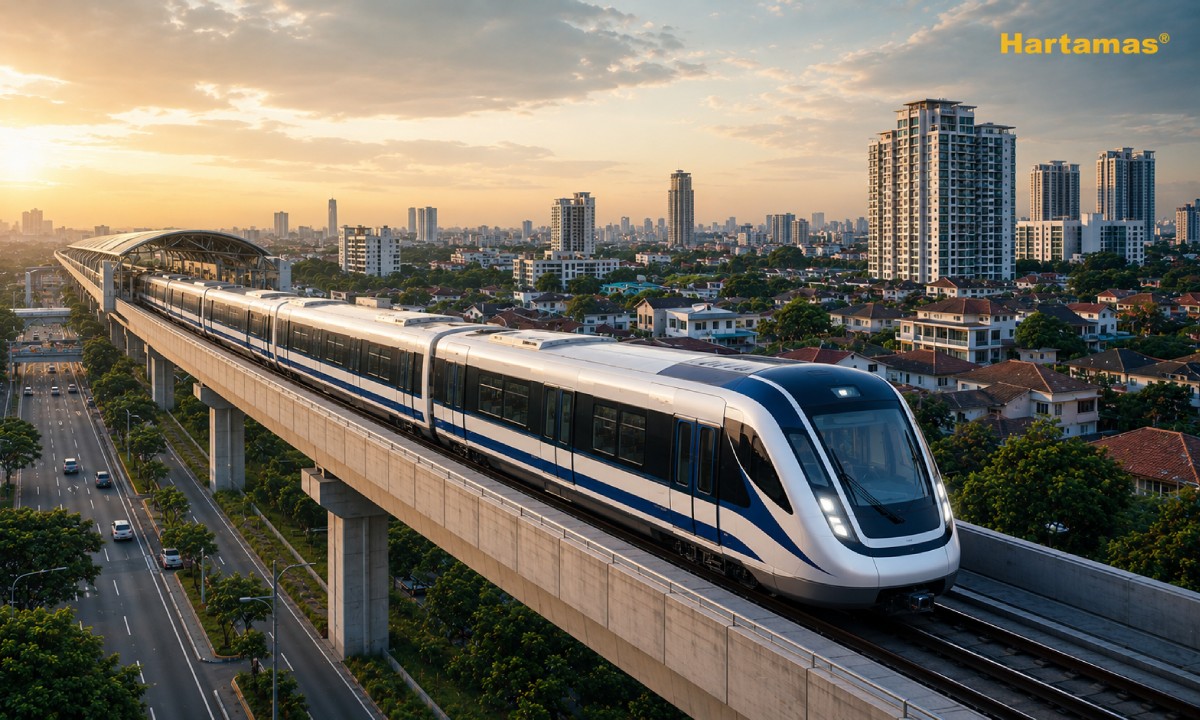
LRT3 Is Open: What Past Rail Launches Tell Us About Property Prices

LRT3 property decisions are about to get real. The LRT3 Shah Alam Line begins passenger service on 29 June 2026, following an official ceremony on 28 June officiated by Prime Minister Datuk Seri Anwar Ibrahim.
The 37.8-kilometre line connects Bandar Utama in Petaling Jaya to Johan Setia in Klang, with 20 operational stations at launch. Five additional in-fill stations are scheduled to open by 2028.
Most coverage of this launch reads like a station list attached to new-launch advertisements. This article takes a different approach.
We look at what actually happened to property prices after the last two major Klang Valley rail openings. Then we apply those lessons to LRT3, station by station.
TL;DR
- Opening date: 29 June 2026. Fares capped at RM4.90 cash, RM4.30 cashless, RM2.40 concession.
- PJ stretch (Tier 1): Marginal upside. These areas already have rail.
- Shah Alam core (Tier 2): Strongest near-term case. First real rail access for a car-dependent corridor.
- Klang stretch (Tier 3): Biggest transformation potential, but requires a longer holding period.
- Key caution: Transit premiums historically show up after a line stabilises operationally, not at launch. It pays to be cautious about anticipation pricing.
In This Article
- What Did Past Klang Valley Rail Launches Do to Property Prices?
- Which LRT3 Stations Are Worth Buying Near?
- Should You Buy Subsale or New Launch Near LRT3?
- What Should Each Buyer Type Do About LRT3?
- What Are the RPGT and Holding Period Implications?
- LRT3 Station Cluster Snapshot
- Frequently Asked Questions
- Conclusion: What Does LRT3 Mean for Your Next Move?
1. What Did Past Klang Valley Rail Launches Do to Property Prices?
Transit premiums in the Klang Valley tend to follow a pattern:
- Prices build during the construction phase.
- They soften around launch.
- Premiums stabilise 12 to 24 months after the line is fully operational.
Two recent precedents are worth studying.
The Kelana Jaya Line extension completed on 30 June 2016. The MRT Kajang Line followed in July 2017. Both coincided with a broader market correction, and NAPIC data shows overall property transaction volumes declined 11.5% in 2016. Loan approvals shrank by 15.3% in the same period.
Despite this softening, properties within walkable distance of active stations held stable valuations. They also recorded positive rental growth.
Properties in older, non-connected neighbourhoods experienced both rental and capital depreciation.
The key takeaways from these corridors:
- Rail connectivity acts as a defensive buffer during downturns, helping to preserve occupancy and liquidity.
- Speculative premiums priced in during construction tend to correct once the line opens.
- Sustainable premiums tend to emerge after the system has been running reliably for 12 to 24 months.
In Petaling Jaya, older condominiums that had heavily priced in anticipated LRT connectivity saw transacted prices normalise once the line opened and buyers could assess actual commute patterns and station accessibility.
Pro Tip: There is no rush to buy before launch day. The sustainable transit premium typically emerges 12 to 24 months after operations stabilise. Patience has historically rewarded buyers in every Klang Valley rail corridor.
2. Which LRT3 Stations Are Worth Buying Near?
Not all stations are equal. We score each station catchment on a 10-point Transit Catchment Score (TCS) based on five factors:
- Walkable distance to the nearest housing.
- Train frequency and capacity.
- Interchange value with existing rail lines.
- Existing demand drivers nearby (universities, hospitals, malls, offices).
- First-rail uplift potential (the inverse of existing rail redundancy).
The scores sort the 20 operational stations into four tiers.
Tier 1: Already Served (Score 3–5)
Stations: Bandar Utama, Kayu Ara, BU 11, Damansara Idaman, Subang.
These Petaling Jaya areas are already served by the MRT Kajang Line, LRT Kelana Jaya Line, or major highway networks. LRT3 adds convenience but not a structural shift. Capital upside is modest.
Tier 2: First Real Rail (Score 7–9)
Stations: Glenmarie 2, Kerjaya, Stadium Shah Alam, Dato’ Menteri, UiTM Shah Alam, Seksyen 7.
This is the transformation zone.
Shah Alam has been almost entirely car-dependent for decades. The UiTM Shah Alam campus alone has over 40,000 students, and Stadium Shah Alam anchors major retail and sports hubs.
This tier scores highest on the TCS. It represents the strongest near-term capital and rental potential.
Tier 3: Highest Transformation, Longest Runway (Score 5–7)
Stations: Bandar Baru Klang, Pasar Klang, Jalan Meru, Jambatan Kota, Taman Selatan, Seri Andalas, Klang Jaya, Bandar Bukit Tinggi, Johan Setia.
Klang’s established residential districts see the biggest structural change.
The market here is dominated by affordable landed housing. Capturing the full transit premium may require an extended holding period as high-density development gradually builds out around these nodes.
Tier 4: Wait and Watch (Score 1–3)
Stations: Tropicana, Temasya, Raja Muda, Bukit Raja Selatan, Bandar Botanik.
These five in-fill stations were reinstated under Budget 2024, at a cost later revised to RM5.3 billion. These stations will not be operational at launch. Trains will pass through without stopping until completion, targeted for 2028.
It is worth waiting until these stations are fully operational before paying a transit premium for nearby properties.
Pro Tip: Ask one question before you buy near any LRT3 station: can I walk to the platform entrance in under 10 minutes, on a safe, covered path? If the answer is no, the transit premium tend to be weak regardless of the station’s tier.
3. Should You Buy Subsale or New Launch Near LRT3?
Both new launches and subsale properties along the LRT3 corridor have genuine merit. The right choice depends on your timeline, budget, and appetite for trade-offs.
The case for new launches
- Newer facilities, modern layouts, and developer defect-liability coverage for the first 24 months after vacant possession.
- Many new projects near LRT3 stations are designed as transit-oriented developments (TODs), with direct covered links to station entrances.
- Entry prices can be competitive. Projects along the Shah Alam stretch start from RM250,000 to RM450,000 for units ranging from 550 to 958 square feet.
- Some developers offer early-bird pricing, rebates, or absorption of legal and stamp duty costs, which can reduce upfront cash outlay.
The trade-off: most new launches along this corridor complete in 2027 or 2028. That means servicing progressive loan payments during the construction period without rental income. Multiple projects completing near the same stations at the same time could also create temporary competition for tenants.
The case for subsale
In Klang district, the median residential transaction price is RM477,000 at a median of RM334.83 per square foot (NAPIC, Central Region Report 2025).
- You get a completed asset you can move into or rent out immediately.
- Mature neighbourhoods come with established amenities: schools, parks, clinics, and wet markets already in place.
- Established double-storey terraces in Bandar Bukit Tinggi transact between RM650,000 and RM760,000 (NAPIC, 2025), offering more space per ringgit than most new high-rise units.
The trade-off: older stock may need renovation, facilities are less modern, and some resale properties may sit further from the station entrance than purpose-built TODs.
Pro Tip: At Hartamas, we work with both new launches and subsale stock across the LRT3 corridor. The best approach is to compare like for like within the same station catchment, then weigh the trade-offs against your personal timeline and holding capacity. For a deeper breakdown of the pros, cons, and suitability of each option, read our guide on new launch vs subsale properties.
4. What Should Each Buyer Type Do About LRT3?
The right move depends on your buyer profile, timeline, and holding capacity.
| Buyer Type | Verdict |
|---|---|
| First-time owner-occupier |
|
| Upgrader |
|
| Yield-focused investor |
|
| Pure speculator |
|
Source: Hartamas Real Estate advisory framework, June 2026.
5. What Are the RPGT and Holding Period Implications?
Most new launches along the LRT3 corridor complete in 2027 or 2028. Factor that holding period into any appreciation thesis before the transit premium can even be tested.
Under Malaysia’s current RPGT schedule:
Malaysian citizens and PRs:
- Years 1 to 3: 30% on chargeable gains.
- Year 4: 20%.
- Year 5: 15%.
- Year 6 onwards: 0%.
Foreign buyers:
- Years 1 to 5: 30%.
- Year 6 onwards: 10%.
A six-year minimum holding period is the optimal strategy for domestic investors along this corridor. This aligns naturally with the operational stabilisation timeline of the transit line itself.
On rental yields, it helps to underwrite conservatively. In comparable mass-market transit hubs across the Klang Valley, gross yields typically range from 4.5% to 6.5%.
Along LRT3 Tier 2 and Tier 3 segments, realistic gross yields of 5.0% to 6.5% are a reasonable starting estimate. Yields are likely to strengthen as ridership stabilises.
Pro Tip: For buyers considering a flip within three years, the RPGT alone could take a significant portion of the gain. LRT3 corridor properties tend to reward patient capital. Holding for six years brings the RPGT liability for citizens down to zero.
6. LRT3 Station Cluster Snapshot
A scannable summary of what each tier means for buyers.
| Tier | Stations | Best Suited For | Verdict |
|---|---|---|---|
| Tier 1 | Bandar Utama, Kayu Ara, BU 11, Damansara Idaman, Subang | Established families wanting convenience | An established location that may appeal to buyers seeking stability over rapid growth. |
| Tier 2 | Glenmarie 2, Kerjaya, Stadium Shah Alam, Dato’ Menteri, UiTM Shah Alam, Seksyen 7 | Investors, student landlords, young renters | Highest growth potential. First rail transforms these car-dependent nodes. |
| Tier 3 | Bandar Baru Klang through Johan Setia (9 stations) | First-time buyers, upgraders seeking landed homes | Strong long-term potential, but it may take time to see results. |
| Tier 4 | Tropicana, Temasya, Raja Muda, Bukit Raja Selatan, Bandar Botanik | Long-horizon strategic investors only | For buyers prioritising transit access, it may be worth reassessing once stations become operational (expected around 2028). |
Source: Hartamas Real Estate Transit Catchment Score framework. Station data sourced from Prasarana and Transport Ministry confirmations.
7. Frequently Asked Questions
When does LRT3 open?
LRT3 begins full public passenger service on 29 June 2026. The official inauguration ceremony takes place on 28 June 2026, officiated by Prime Minister Datuk Seri Anwar Ibrahim.
Does LRT3 increase property value?
Historical data from past Klang Valley rail launches points to yes, but with conditions.
- Properties within walkable distance of a station typically command a premium of 10% to 20% over comparable properties further from the station.
- This premium is driven by reduced commute costs and stronger tenant demand.
- It tends to materialise during the operational stabilisation phase, not at announcement or launch.
Which LRT3 station is best to buy property near?
It depends on your buyer profile:
- Investors: Tier 2 stations (Stadium Shah Alam, Dato’ Menteri, UiTM Shah Alam) offer the strongest near-term rental performance.
- Owner-occupiers seeking landed housing: Tier 3 stations (Bandar Baru Klang, Bandar Bukit Tinggi) offer the most competitive entry prices.
What is the status of the five unfinished LRT3 stations?
The five in-fill stations are Tropicana, Temasya, Raja Muda, Bukit Raja, and Bandar Botanik.
- They were reinstated under Budget 2024 at an initial cost of RM4.7 billion, later revised to RM5.3 billion.
- Targeted completion and operational service: 2028.
- Until then, trains pass through these locations without stopping.
Should I buy near LRT3 now or wait?
It depends on what you are buying:
- Subsale stock near operational Tier 2 and Tier 3 stations: The case is strong. Prices have not yet fully absorbed the transit premium.
- New launches near Tier 4 stations: Waiting may be the more prudent approach. These stations will not function until 2028.
8. Conclusion: What Does LRT3 Mean for Your Next Move?
The LRT3 Shah Alam Line is a genuine inflection point for property in the western Klang Valley. But not every station is created equal, and not every purchase near the line will benefit equally.
Here is what the evidence suggests:
- Transit premiums are real, but they take time. Past Klang Valley rail corridors show that sustainable price uplift arrives 12 to 24 months after a line stabilises, not on opening day.
- Tier 2 (Shah Alam core) offers the strongest near-term combination of capital growth and rental demand, driven by student populations and first-rail access.
- Tier 3 (Klang) offers attractive long-term value, particularly for buyers seeking landed homes at more affordable price points than other parts of the Klang Valley.
- Both new launches and subsale stock have genuine merit along this corridor. New launches offer modern facilities and TOD design; resale offers immediate occupancy in mature neighbourhoods. The right choice depends on your timeline and holding capacity.
- The five in-fill stations (Tier 4) are worth monitoring, but it is early to price in their transit premium before they become operational in 2028.
The best approach, regardless of buyer profile, is to focus on the fundamentals: walkable distance to a functioning station, the strength of local demand drivers, and a holding period that aligns with both RPGT schedules and the line’s operational maturity.
At Hartamas, we are active across the LRT3 corridor. If you would like an on-the-ground perspective for any of these station catchments, we are happy to help.
Before you make a decision, continue with these guides:
Looking at LRT3 Corridor Properties?
Hartamas Real Estate agents cover the Tier 2 and Tier 3 catchments on the ground. We work with both new launches and subsale properties, so we can give you an honest view of what suits your budget and timeline.
Speak to a Hartamas agent today for personalised recommendations, or explore our listings to see what’s available in your preferred locations and budget range.
Not sure whether to buy subsale or off-plan? Tell us your budget and preferred area and we will advise. No obligation.

How much housing loan you can get?

How much is your property worth?

Interested in new launch property?

Looking for property for sale or rent?
Subscribe to our email newsletter today to receive updates on the latest news, property guides, new launches, featured secondary market properties and special offers.

Hartamas Research
A market intelligence desk by Hartamas Real Estate.
Hartamas Research is the property market intelligence desk of Hartamas Real Estate. The team analyses Malaysian property trends, housing policy, financing conditions, transaction data, and buyer behaviour to produce practical guides for homebuyers, investors, landlords, and occupiers.