

TL;DR
-
The Core Shift: The traditional commercial real estate playbook has inverted. While broader Kuala Lumpur purpose-built office markets show high vacancy, premium Grade-A and green-certified office spaces face a sharp localized supply crunch. Concurrently, industrial properties have emerged as the market’s star performers, driven by a RM23.7 billion transactional surge.
-
The Macro Data: Official NAPIC data places broader office occupancy within the 72.3% to 78.1% margin, masking a massive Flight to Quality. Meanwhile, industrial transaction values have climbed 14.6% year-on-year due to global supply chain re-alignments.
-
The Risks: Office occupiers moving to premium fringe towers face an expensive Reinstatement Trap upon exit. Conversely, industrial tenants racing to expand face severe operational delays if they fail to audit power grid capacities and structural loading limits before signing.
-
The Strategy: Businesses can no longer treat real estate as a simple space search. Corporate tenants must integrate commercial leasing negotiations with preliminary space planning 9 to 18 months before a move to protect capital and cash flow.
For decades, the traditional corporate real estate playbook in Malaysia followed a highly predictable, linear path. Prime office towers in the heart of the Kuala Lumpur City Centre (KLCC) were the undisputed crown jewels of corporate prestige and institutional investment portfolios. Industrial properties, by contrast, were often relegated to the background—viewed as secondary, utilitarian assets meant strictly for basic inventory storage.
Today, that script has been completely turned on its head.
A profound structural divergence is reshaping the Malaysian commercial property landscape. The rules of supply, demand, and landlord-tenant leverage have undergone a total reversal. For C-suite executives, CFOs, and institutional investors, understanding this asset-class split is no longer just an academic exercise—it is a baseline requirement for corporate capital preservation.
The Great Divergence: By the Numbers
To understand how deep this flip goes, we must look past broad market rumors and focus directly on verified, official national metrics.
According to the latest commercial updates released by the National Property Information Centre (NAPIC) and the Valuation and Property Services Department (JPPH), the broader purpose-built office sector continues to work through supply pressures, with national office occupancy rates holding within the 72.3% to 78.1% margin.
Yet, looking at that broad baseline figure alone misses the real story: the office market is experiencing a profound structural split known as market Bifurcation.
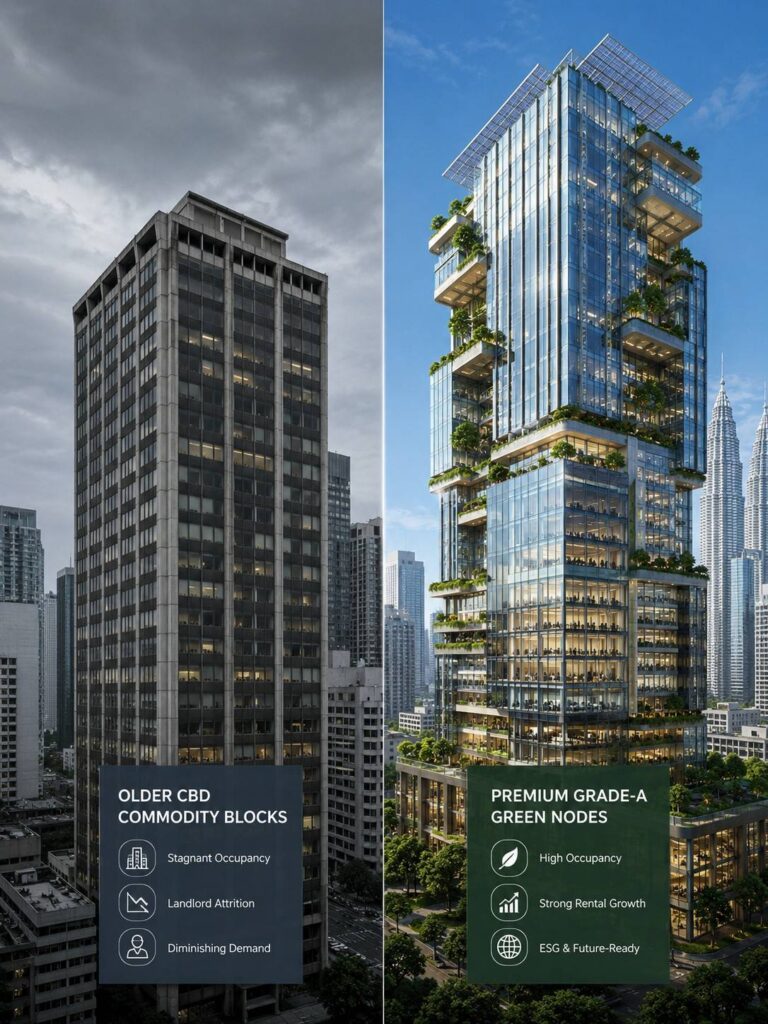
While older commodity office blocks in dense central business districts are seeing vacancies climb and landlords aggressively drop rates, premium spaces are experiencing a severe localized supply crunch. Corporate occupiers are executing a dual strategy: a structural “Flight to Quality” and an environmental “Flight to Green.” This shift is driven by the urgent need to meet strict international corporate compliance mandates and create highly attractive environments to draw talent back to the workspace.
This trend has created a stark contrast in sub-market performance. While secondary, non-transit-oriented spaces struggle with tenant retention, prime corporate hubs located along well-connected city fringes—such as Bangsar South, Mid Valley City, and KL Sentral—are experiencing exceptionally tight availability. This intense demand has consistently insulated prime average rental rates in elite nodes.
Furthermore, sustainability has shifted from an optional marketing buzzword to a direct financial driver. Data monitored by independent economic trackers reveals that green-certified, energy-efficient corporate buildings are securing significant rental premiums over non-green buildings, with ultra-premium Grade-A green office assets hitting historic performance heights.
Readily available inventory is tightening. Meanwhile, the industrial sector has broken all historical records to become the undisputed star performer of the Malaysian economy. Driven by a massive surge in manufacturing foreign direct investment (FDI) and regional supply chain diversification under the global “China + 1” strategy, national industrial transaction values have skyrocketed by 14.6% year-on-year, reaching an unprecedented RM23.7 billion.
The “Specification Crunch” and the Rise of High-Tech Industrial Corridors
However, “industrial real estate” no longer means what it did a decade ago. The unprecedented influx of advanced semiconductor assemblies, electrical and electronic (E&E) manufacturing, and cold-chain logistics has triggered what we at Hartamas call the Specification Crunch.
The contemporary industrial occupier isn’t looking for simple, empty storage; they require properties engineered to extreme technical and utility tolerances. Modern facilities must feature high floor-loading capacities, Early Suppression Fast Response (ESFR) sprinkler networks, and massive, uncompromised power allocations.
This shift is incredibly apparent when comparing key specialized industrial corridors within Selangor:
- Shah Alam: Capitalizing on its mature, central infrastructure and remarkable historical growth, it remains the highest-priced, premium industrial sub-market in the state, commanding an average of RM248 per square foot.
- Bukit Raja: Backed by massive modern master-planning, it has emerged as the go-to corridor for stable, institutional-grade logistics hubs and modern, built-to-suit speculative layout facilities, offering spaces at a strategic average of RM139 per square foot.
Simultaneously, the digital infrastructure boom has turned parts of the Klang Valley into a playground for global tech giants. According to industrial tracking data monitored by national investment agencies, Malaysia’s operational data center capacity is on track to cross 2,055MW over the near term.
This hyper-growth is anchored in specialized hubs like Cyberjaya. This is highlighted by major announcements covered heavily in national financial media, such as global digital infrastructure leaders breaking ground on massive, purpose-built international data centers. These modern facilities are engineered with specialized liquid-cooling infrastructure designed explicitly to run next-generation distributed AI workloads.
Strategic Blind Spots: The Operational Risks of the Market
Because the dynamics of both sectors have shifted so rapidly, corporate decision-makers can no longer treat real estate as a simple transactional space search. The operational stakes on both sides of the coin have heightened significantly, exposing businesses to two massive blind spots:
1. The Office Blind Spot: The Reinstatement Trap
With landlords of secondary office buildings fighting to keep tenants, many companies are capitalizing on the market split to relocate to premium fringe towers. However, CFOs are routinely blindsided by the Reinstatement Clause at the tail end of their current tenancy agreements. Tearing down custom glass partitions, removing built-in fixtures, hacking up premium flooring, and restoring complex mechanical, electrical, and fire protection systems back to the landlord’s original bare shell condition can easily cost tens of thousands of Ringgit—quietly wiping out the financial savings of the move itself.
2. The Industrial Blind Spot: The Infrastructure Delay
On the flip side, expanding manufacturers or e-commerce operators racing to secure scarce industrial space often sign leases based on location alone, assuming utility infrastructure can be upgraded later. This is a multi-million Ringgit gamble. Waiting for TNB power grid upgrades, modifying outdated layouts to achieve BOMBA fire compliance, or upgrading floor-loading capacities can delay operational commencement by six to nine months, resulting in massive supply chain disruptions and unexpected capital expenditure overruns.
Navigating the Flip with Total Solutions
In an environment where market leverage can shift completely from one asset class to another within a twenty-minute drive, businesses can no longer afford to operate in silos. You cannot decouple your leasing contract from your spatial layout, nor can you separate your property search from raw engineering and valuation data.
This is exactly where the value of an integrated real estate partner becomes clear.
At Hartamas Real Estate Group, we have been unearthing hidden potential in Malaysia’s corporate landscape since 1996. With an active workforce of over 500 professionals across six major national offices and an international presence in Taiwan, we offer a total solutions ecosystem that bridges the gap between transactional real estate and operational reality.
- For Office Occupiers: Our core commercial leasing and tenant representation teams help you maximize the current market split. We advise starting your search 9 to 18 months early, allowing us to utilize data-backed market analytics to legally force landlords into conceding extended rent-free fit-out periods, capped service charges, and protective contract terms.
- For Industrial Operators: Our specialized industrial advisory divisions work alongside technical space planners and valuation analysts to deep-audit facilities before an offer letter is signed—verifying zoning compliance, structural capacities, and grid readiness so your operations open on time, without the budget overruns.
The commercial script in Malaysia has flipped, but with the right data, strategy, and partner, your business can write its own successful chapter.
Frequently Asked Questions (FAQ)
Q1: What is the current occupancy rate for commercial office spaces in Malaysia?
According to official property registry benchmarks monitored by NAPIC, the broader purpose-built office occupancy rate across Malaysia ranges between 72.3% and 78.1%. However, the market is severely bifurcated. Commodity business districts face higher vacancy, while premium Grade-A, green-certified office spaces along the city fringes (such as Bangsar South and Mid Valley City) face exceptionally tight availability due to a massive corporate flight to quality.
Q2: What are the primary drivers behind the Malaysian industrial real estate boom?
The unprecedented growth in the Malaysian industrial market—which saw an annual transaction value surge of 14.6% to RM23.7 billion—is driven by regional supply chain diversification under the global “China + 1” strategy, increased multinational manufacturing foreign direct investment (FDI), and an exponential boom in high-tech digital infrastructure deployments, including speculative Grade-A logistics warehouses and specialized AI data centers.
Q3: What is an office reinstatement clause, and how does it affect corporate tenancy exits in Malaysia?
An office reinstatement clause is a standard legal obligation in commercial tenancy agreements that requires a tenant to return their leased space to its original, vacant, bare shell condition upon lease expiration. This involves tearing down custom glass partitions, removing built-in joinery, dismantling flooring, and restoring core mechanical, electrical, and fire protection layouts. If not audited early, reinstatement expenses can cost corporate occupiers tens of thousands of Ringgit during relocation.
Q4: How early should a business begin negotiating a commercial lease renewal or relocation in Malaysia?
To maximize contract leverage, a business should ideally begin its properties search and lease lifecycle planning 9 to 18 months before the move-in or expiration date. Starting early allows corporate tenants to effectively negotiate crucial concessions, such as rent-free fit-out periods, capped service charge escalations, and favorable rent review frameworks before landlords gain the upper hand due to timeline pressures.