
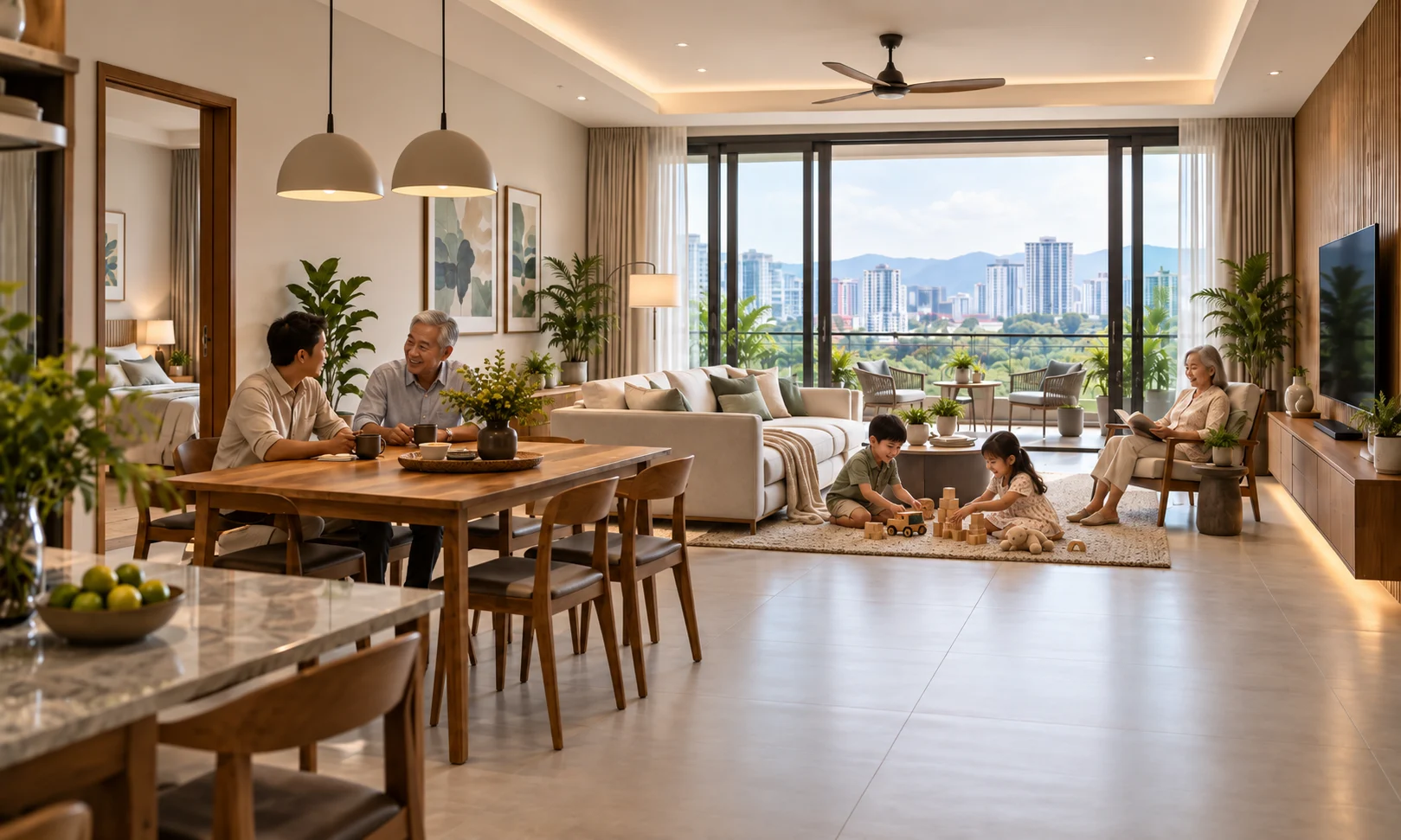
A practical framework for judging whether an ordinary Malaysian home will still work well when the people living in it are older.
If you’re planning to hold property in Malaysia for years to come, it helps to understand how the country’s ageing population is starting to shape investment decisions. By 2025, 8.0% of Malaysians were aged 65 or older, up from 6.8% in 2020, a shift that matters less for what you buy today, and more for how long it stays practical for you.
At Hartamas Real Estate, we spend a lot of time helping buyers and investors across the Klang Valley weigh exactly this question. In this guide, we’ll walk you through a seven-point test designed for anyone planning to own, rent out, or resell a property for ten years or more.
TL;DR — Quick Summary
- Malaysia’s 65+ population reached 8.0% in 2025: up from 6.8% in 2020. DOSM projects it will nearly triple to 18.3% by 2060.
- Ageing alone isn’t an investment thesis: it can shift housing needs, but price, location, supply, and demand still tend to decide returns.
- Seven checks matter more than the property label: access, adaptability, daily convenience, healthcare, mobility, maintenance and exit breadth.
- No property type is automatically future-proof: a well-managed condo, a single-storey terrace and a large landed home each carry different trade-offs.
- Current demand should count more than future promises: resale activity, rental interest and occupancy tend to matter more than demographic projections.
Table of Contents
How Does Malaysia’s Ageing Population Affect Property Investment?
An ageing population tends to raise the importance of accessibility, manageable upkeep, healthcare access, and transport options in a home.
Malaysia’s older population has been growing steadily:
- Aged 65 and above: 6.8% in 2020, rising to 8.0% by 2025.
- Old-age dependency ratio: 11.4 in 2025, up from 10.9 the year before.
- Fertility rate: down to 1.6 children per woman in 2024, below replacement level since 2013.
- Life expectancy: up from 63.6 years in 1970 to an estimated 74.8 years in 2023.
Estimates for when Malaysia becomes an “aged nation” vary, since sources use different thresholds and projection years:
- Ageing society (7% aged 65+): reached between 2021 and 2023, depending on the estimate used.
- Aged society (14% aged 65+): projected for 2048 by the Ministry of Finance. A separate DOSM projection puts 17.3% of the population aged 60+ by 2040.
Demographics can tell us that housing needs may change. They rarely tell us which specific project will appreciate.
In our view, ageing is worth factoring in, but it should sit alongside the fundamentals that already drive Malaysian property performance:
- Price and affordability: relative to local household incomes.
- Location and existing demand: not future projections.
- Supply and transaction activity: not brochure claims.
- Maintenance, rental market, and resale liquidity: how easily you could sell or re-let if plans change.
Pro Tip: we like to treat ageing statistics as useful context for liveability — not a signal to chase a specific neighbourhood or project type.
Weighing whether now’s the right time to buy at all? Should I Buy a House Now or Wait? A Practical Guide for Malaysian Buyers covers that in more depth.
Should You Buy Senior-Living Property Because Malaysia Is Ageing?
Your decision shouldn’t rest on demographics alone. Any senior-living property still needs to earn its place on price, ownership structure, running costs, actual demand, and resale options.
Purpose-built senior living may become more relevant as Malaysia ages. But it’s still only one part of the housing market. Most Malaysians will likely keep living in conventional housing:
- Condominiums and apartments in established neighbourhoods.
- Terrace and semi-detached homes in mature landed enclaves.
- Other landed housing: bungalows and cluster homes.
Malaysian research backs this up. Studies on preparedness to age in place and a separate Klang Valley strata housing study both point the same way: many older Malaysians would rather stay in their own homes and communities than relocate.
It helps to separate two questions. Senior housing asks what’s designed specifically for older residents. Future-proof housing asks something broader: can an ordinary home still work as someone’s mobility, transport, and maintenance needs change?
Pro Tip: if a senior-living project has caught your eye, we’d encourage you to check its ownership structure and resale market first, rather than assume the ageing trend alone will carry it.
What Is the 7-Point Future-Proof Property Investment Test for Malaysia’s Ageing Population?
The seven-point test checks access, adaptability, convenience, healthcare, mobility, maintenance, and exit breadth. Together, these tend to be more useful than guessing what older Malaysians will want to buy in the future.
If you’re planning to hold a property for ten years or more, we’d encourage you to work through each check below before making an offer.
|
Test |
Core Question |
|
|---|---|---|
|
1 |
Access |
Can someone reach and move through the home without relying on stairs? |
|
2 |
Adaptability |
Could the home change as its owner’s needs change, without major works? |
|
3 |
Daily convenience |
How much of everyday life is realistically within reach? |
|
4 |
Healthcare |
Is care accessible without being the entire investment thesis? |
|
5 |
Mobility |
What happens if driving becomes less convenient? |
|
6 |
Maintenance |
Will the property become harder to own over time? |
|
7 |
Exit breadth |
Who else, beyond one narrow buyer profile, could want this property? |
Source: Hartamas Real Estate analysis.
1. Can Someone Reach the Home Without Relying on Stairs?
Access really comes down to how someone actually moves through a home, not the property type on paper. Here’s what we’d look at:
- Entrance: step-free, or close to it.
- Lifts: availability, reliability, and how many serve the building.
- Distance: from parking or drop-off to the front door.
- Layout: internal staircases, and ground-floor bedroom potential for landed homes.
A condo with lifts can look accessible on paper, but unreliable lifts tell a different story. A landed home might offer more space, yet still be hard to live in if every bedroom sits upstairs.
2. Can the Home Change as Its Owner Changes?
Adaptability is about whether small changes, not a full renovation, would keep a home usable later. Worth considering:
- Bathrooms: layout, shower access, slip risk.
- Thresholds: any steps between rooms.
- Doorways: width and swing direction.
- Flexible rooms: a ground-floor room that could later become a bedroom.
The goal isn’t to turn every home into a senior residence. PLANMalaysia’s Universal Design guidelines covers this ground well, from wider doorways to step-free bathrooms. The real question we’d ask: would simple changes keep the home usable, or would it need major structural work?
Pro Tip: we’d take a close look at whether a bathroom can fit grab bars and a step-free shower without moving any plumbing lines.
3. How Much of Everyday Life Is Actually Nearby?
Daily convenience is about whether someone could run most weekly errands without a long drive, not marketing lines like “everything nearby.” Worth assessing:
- Groceries and pharmacy: within a short, realistic distance.
- Clinic and banking: for routine needs.
- Community facilities: that residents would actually use.
And this isn’t only useful for older residents; families with children, non-drivers, single-car households, and remote workers benefit too. Future-proof features tend to broaden demand rather than narrow it.
4. Is Care Accessible Without Becoming the Whole Investment Thesis?
Healthcare access can improve liveability. On its own, though, hospital proximity rarely makes a property a good investment. Worth checking:
- GP or clinic: for routine visits.
- Pharmacy and specialist care: within reasonable travel time.
- Hospital and emergency routes: that stay clear at peak hours.
We’d always treat healthcare as one part of a well-rounded neighbourhood, not a reason to buy on its own.
5. What Happens if Driving Becomes Less Convenient?
Mobility comes down to realistic alternatives to driving, not the distance printed in a brochure. Worth assessing:
- Rail, bus and e-hailing: coverage at different times of day.
- Pedestrian conditions: road crossings, gradients, covered walkways.
- Drop-off areas: near the entrance, not just the compound gate.
A brochure might say the MRT is 500 metres away, but that distance can still mean steep terrain, major roads, or unsafe crossings. We’d always suggest walking the route yourself before committing, rather than judging from Google Maps or a sales gallery alone.
Pro Tip: we’d suggest walking the route to the nearest transit stop yourself, at the time of day you’d actually use it.
6. Will the Property Become Harder to Own Over Time?
Maintenance burden comes down to the work, money, and coordination a property needs, not simply its size. Older buyers don’t automatically prefer smaller homes, in our experience.
- Landed property: roof, exterior, garden, security, plumbing, stairs, unused rooms.
- Strata property: maintenance fees, sinking fund, building condition, lift upkeep, management quality.
Low-maintenance and small aren’t the same thing. A badly managed condo can create more headaches than a straightforward landed home ever would.
7. Who Else Would Want This Property?
Exit breadth is about whether more than one type of household would want the property, not predicting exactly what a future senior buyer might choose. This tends to be the most telling of the seven. Worth asking:
- Household range: would a young couple, a family, or someone caring for ageing parents all find this workable?
- Independent seniors: could an older couple manage here without major changes?
- Evidence, not promises: is there an existing rental market and real resale transactions?
We’d always check completed transactions and rental data through NAPIC’s property market reports, rather than rely on a project’s own demand projections.
A truly future-proof property usually has more than one reason for people to want it. Ageing-related features should expand its appeal, not turn it into a niche bet.
Pro Tip: we’d always ask for real resale and rental transaction data before taking a demographic sales pitch at face value.
Is a Condo or Landed Property More Future-Proof?
There’s no single future-proof property type, since accessibility, layout, maintenance, transport and everyday convenience typically matter far more than whether a property is strata or landed.
|
Property Type |
Potential Strength |
Main Consideration |
|---|---|---|
|
Lift-served condo |
Easier access and less individual upkeep |
Lift reliability, strata fees, management quality |
|
Walk-up apartment |
Lower entry price in some locations |
Stair dependency |
|
Single-storey landed |
Easier internal movement |
Maintenance and car dependence |
|
Multi-storey landed |
Space and multigenerational flexibility |
Stairs and upkeep |
|
Senior-oriented property |
Purpose-designed accessibility and services |
Specialist demand, recurring costs, exit structure |
Source: Hartamas Real Estate analysis, based on the seven-point future-proof property test.
Pro Tip: we’d weigh any property against the seven-point test before ruling it out on its label alone.
What Red Flags Suggest a Property Won’t Age Well With Its Owners?
Three red flags tend to matter most: a structural accessibility problem, total dependence on driving, and an investment case built on future demographics rather than current demand.
Is the Accessibility Problem Structural?
A structural accessibility problem can follow a property for decades. A cosmetic issue is usually easier to fix. Worth watching for:
- Unavoidable stairs: with no reasonable way to add a step-free route.
- Difficult access: from parking to the front door.
- Impractical layouts: or major level changes within the home.
Does Everyday Life Depend Entirely on Driving?
Relying entirely on a car is a long-term risk worth weighing, not a reason to rule out every suburban property. It’s worth asking yourself whether a resident would have a realistic alternative if driving became less convenient one day.
If food, healthcare, groceries, and daily errands all depend on a car, that’s worth real consideration for a property you plan to hold for the long term.
Does the Investment Case Rely on Future Demographics Rather Than Current Demand?
We’d always be cautious of a sales pitch that comes down to “older Malaysians will eventually want this”. Instead, we’d look for evidence people want the property today:
- Resale activity and rental demand: for comparable units nearby.
- Occupancy and neighbourhood maturity: not just sales gallery projections.
- Actual amenities and transaction evidence: rather than planned future upgrades.
Future demographic demand can strengthen an already viable property, but it shouldn’t be relied on to rescue a weak one.
Pro Tip: if a project’s pitch leans heavily on future demographics, we’d gently push back and ask what’s driving demand for it right now.
If you’d like to pressure-test the investment from a few more angles, these guides may help:
First investment property? Avoid these 5 common mistakes.
Worried a project is overhyped? Learn how to spot a speculative trap in KL & Selangor.
Thinking about long-term demand? See what Malaysian property buyers are looking for in 2026.
Frequently Asked Questions
1. How will Malaysia’s ageing population affect property investment?
Ageing tends to raise the importance of accessibility, manageable maintenance, healthcare, and alternatives to driving. On its own, though, demographic ageing won’t determine property prices or guarantee returns — price, location, supply, and demand still matter more.
2. What type of property suits Malaysia’s ageing population?
Look for homes that are easy to access, adaptable, manageable to maintain and close to everyday needs. No single property type — condominium, terrace, or landed — automatically qualifies as future-proof.
3. Is senior-living property a good investment in Malaysia?
It may suit some buyers, but ageing demographics alone rarely tell the whole story. We’d always assess actual demand, price, ownership structure, management, recurring costs and resale options before committing.
4. Is a condo or landed home better for ageing in place?
Neither, automatically. A well-managed lift-served condo may work well, and so may a practical single-storey landed home. Design and location tend to matter more than category.
5. Should I buy property near a hospital because Malaysia is ageing?
Healthcare access can improve liveability, but hospital proximity alone isn’t an investment strategy. Price, neighbourhood quality, transport, existing demand and resale activity still matter more.
Conclusion
Malaysia’s ageing population will gradually change what some households need from their homes, but you don’t need to predict exactly what a 70-year-old Malaysian will want by 2040. The more useful approach, is simply to avoid homes whose usefulness narrows as people’s needs change.
A property with manageable access, adaptable space, everyday convenience, mobility choices and broad buyer appeal has more ways to stay relevant through the different stages of life. The most future-proof property may not look like senior housing at all. It may simply be a good home that still works well when the people living in it are older.
Comparing Two or Three Homes for the Long Term?
|
The market moves fast — let’s talk. Speak to a Hartamas agent today and we’ll build a shortlist around your budget and timeline. Bring us the two or three homes you’re weighing for a long-term purchase, and we’ll help you compare them properly on location, current market demand, transaction activity, physical condition and resale potential, not just launch price or square footage. Weighing a few options for the long term? Tell us about your situation, and we’ll help you think it through, no obligation. |
|---|